
Redefining Key Account Management: From Transactional to Transformational
How business is being done in the life sciences sector is undergoing a profound structural change. Every part of the journey has become more complex, especially for pharmaceutical executives managing key customer accounts.
Accounts are now more complex, with more interdependent decisions made jointly by multiple stakeholders in a company; decisions made must also comply with strict guidelines and payer access.
Customers are also under pressure to show robust outcomes early, amid internal team complexity that makes it a challenge to offer a seamless experience for each account. In other words, today’s go-to-market model for managing key accounts must change drastically to meet new realities.
Recently, I hosted a webinar titled, “Unlock Growth: Navigating the KAM Transformation Journey,” in which I discussed the issues above. The main takeaway from the webinar is that we must move past fragmented, reactive account management and embrace key account management (KAM) transformation to succeed in the years ahead.
New Ways of Doing Business
The problems faced by many account management teams today are all too familiar. Not getting access to key decision-makers means that biopharma companies are not reaping large revenues from top accounts. Conversations are often too short-term and sales-focused, not going beyond products to address a key account’s strategic priorities and pain points.
Team planning at the start of a year sometimes results in teams operating separately and in silos the months after. Without deeper coordination, they fail to deliver the solutions that big accounts require.
To overcome this, biopharma companies might require a shift in mindsets, skills and behaviors when embarking on new KAM efforts. Meaningful transformation in two main areas is crucial.
First, account strategy and planning. Biopharmas, rather than segmenting accounts based on revenue, can look to a broader definition of account value. Instead of just selling products, they can collaborate with accounts on wider initiatives.
Remember, there is no one-size-fits-all approach, so it is crucial to differentiate your investment and engagement as needed. Annual “once and done” account plans also must become more dynamic and shared across the year. Instead of aligning efforts around a brand, they can align the efforts around an account to deliver the unique solution and benefits it needs.
The second area of transformation lies in account management and measurement. The key here is measuring shared outcomes from group effort instead of scrutinizing individual activities. Coordinating across teams gives your business a consolidated voice that is clearer and more impactful as well.
Getting this right delivers the desired outcomes for your KAM efforts:
- Effective and efficient organizational alignment to best serve key accounts
- Differentiated propositions based on the unique needs of those accounts
- Optimal investment and resource allocation for priority accounts
- Efficient and effective execution of plans
- Having the right behaviors and mindset within teams
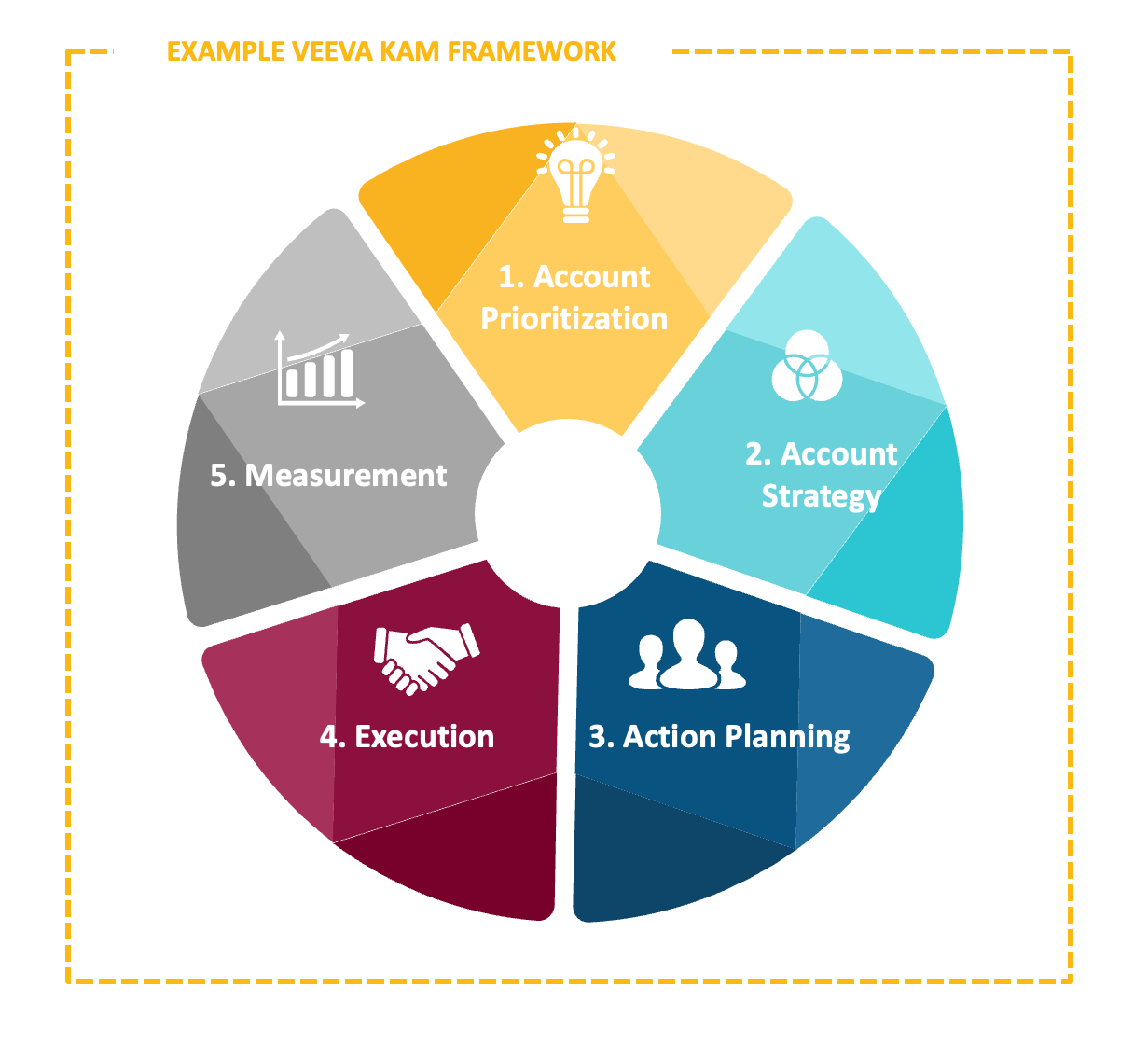
The outcomes above are only possible with the right enablers, such as effective KPIs, cross-collaboration, and strong governance, in place. To get there, Veeva uses a clear framework for high performing KAMs. The framework includes five key elements:
- Account Prioritization (The 'Who'): conduct deep analysis to determine who your most important and influential accounts truly are
- Account Strategy (The ‘Why’): define an account’s problems, which you are uniquely helping them solve, and figure out what shared value looks like for both sides
- Action Planning (The 'What’): set detailed cross-functional plans to achieve those account objectives, including exactly how you allocate resources
- Execution (The 'Do'): govern and manage the actual execution of the plan, making sure insights are captured across all customer-facing teams.
- Measurement (and Change) (The 'Review'): finally, assess performance against the defined objectives and use that data to optimize all future engagement plans.
KAM Transformation Delivers Real Results
Veeva offers customizable KAM components in a CRM dashboard, providing teams with an intuitive workflow to get the job done. On a single screen is information on key account stakeholders, important insights, account objectives, and plan initiatives and tactics. A single, integrated view of the account plan aligns everyone in a company’s KAM efforts.
Already, biopharma companies that have transformed their KAM efforts have seen real results. Some companies now enjoy 30% more growth for launch brands supported by a transformed KAM model. We have also seen a 3x growth rate in more than 15 accounts in just six months, post-KAM transformation.
During the webinar, one audience member asked if the KAM engagement model was better than a marketing-centric one. In response, I said there were different practices in the market.
While some companies go for marketing- or service-centric approaches, others seek a strategic account model. To get the most out of each approach, you need more information about all your accounts so you can optimally support all of them. That’s what KAM transformation allows biopharma companies to do.
Ultimately, there is no silver bullet to KAM, which is getting more complex and challenging. Technology, however, can drastically improve success rates and enable companies to allocate resources in the right direction. In a competitive field, getting KAM right distinguishes a leader from follower.
Take the first step to growth now, Read this White Paper on KAM strategy.