Transforming the QC Lab: Targets, Obstacles, and Time Stealers
Oct 22, 2026 | Justin Lavimodiere
Oct 22, 2026 | Justin Lavimodiere
European quality leaders recently gathered to exchange strategies for modernizing the QC lab. Participants discussed the data and processes in their lab ecosystems, the pain points they are prioritizing, and the biggest challenges standing in the way of lab transformation.
Leader insights reveal a clear trend: QC lab maturity lags behind other areas of quality operations. QC labs remain relatively disjointed, and overly dependent on legacy systems and paper. Quality leaders are aiming to break down data silos and build more automated, digitally connected, and efficient lab activity.
Data flow maturity varies widely
Attendees were asked to describe the current state of their QC lab data infrastructure in just one word. The responses highlight varying maturity levels. While most organizations have digitized individual lab processes — creating disconnected digital islands — manual workarounds and paper-based tracking still heavily persist to bridge operational gaps:
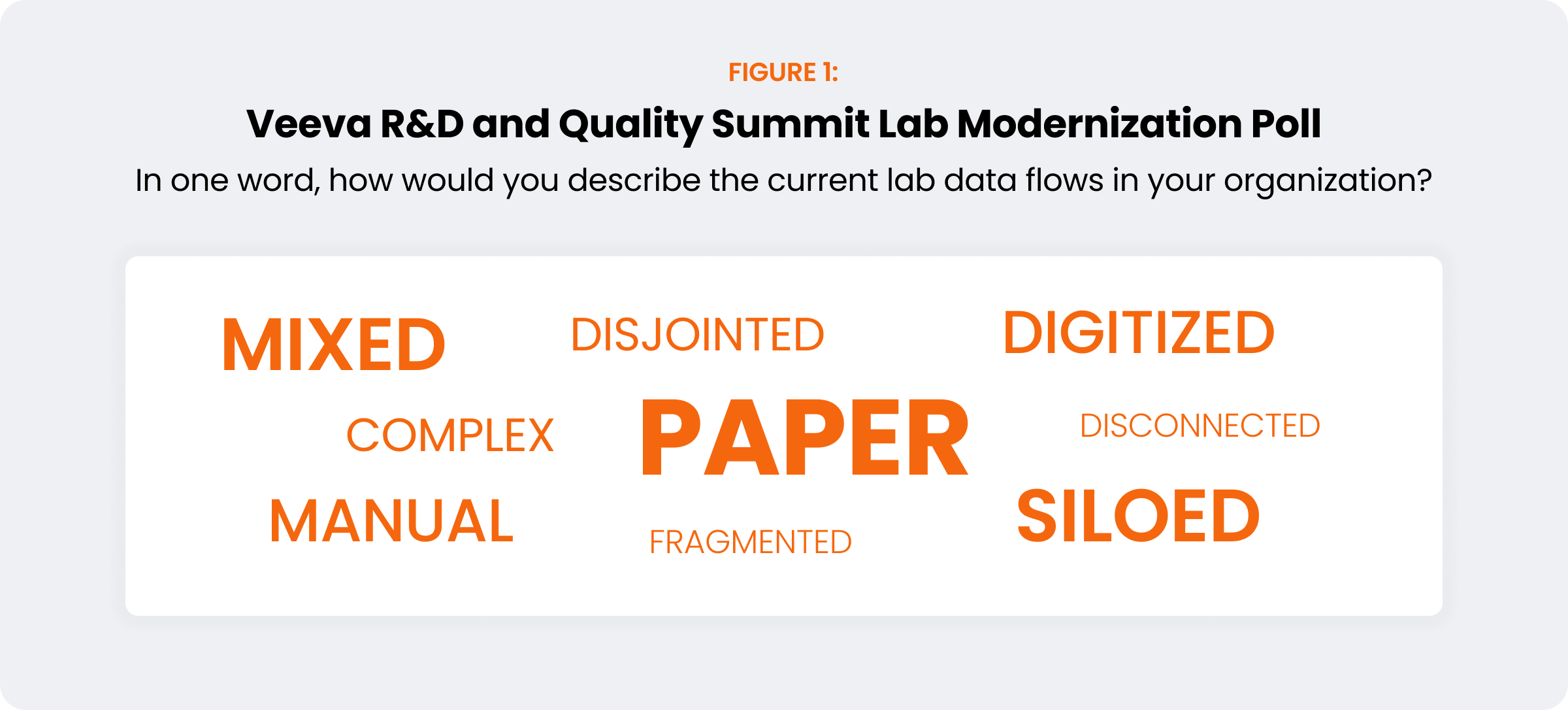
This feedback reflects the general state of QC lab investment. Because of its niche focus and the high barrier to entry for application development, the space has long been antiquated and full of legacy solutions that aren’t innovating. QC labs trail R&D labs and manufacturing lines in operational maturity, with fragmented, paper-based workflows remaining prominent for core GMP processes like sample tracking and test execution. Where digital solutions are in place, they are typically siloed, customized, and defined by architectures and user experiences from several decades ago.
Paper and data gaps are the top time stealers
Quality leaders are recognizing the risks and impact of these antiquated QC lab infrastructures. Several recurring issues drain lab efficiency, with the following ranking in order of severity:
- Paper: Manual creation, distribution, and maintenance of paper lab records consume significant time and introduce data integrity risk. One attendee commented that, “a single misplaced record on paper turns into a full stop for batch approval, adding unnecessary days to our cycle time”. Another noted that, “losing paper records doesn’t just burn budget — it traps product in quality review when it should be shipping”.
- Data: Even if digital laboratory information management system (LIMS) applications are adopted, failing to directly connect them to other business systems poses a challenge for QC lab teams. Emails, paper reports, and meetings are required to bridge the gap and provide updates across the business if LIMS data lives in a separate system from quality, manufacturing, and regulatory data. Custom integrations can be developed to connect processes and data across systems, but integrations require large capital investment and costly upkeep, and integration requirements are as varied as the systems and applications themselves.
- Transcription: Manually transcribing data across records, reports, instruments, spreadsheets, or diverse applications introduces significant risks of human error, while increasing review efforts and extending timelines.
- Reviews: Significant time is lost accessing and reviewing data, obtaining signatures and approvals, and preserving good manufacturing practice (GMP) in paper-heavy environments.
Siloes limiting lab effectiveness
A critical component of QC lab modernization is deepening its connection to the broader quality ecosystem. Attendees rated their current levels of lab unification with QMS, regulatory, and manufacturing activity on a scale of one to three:
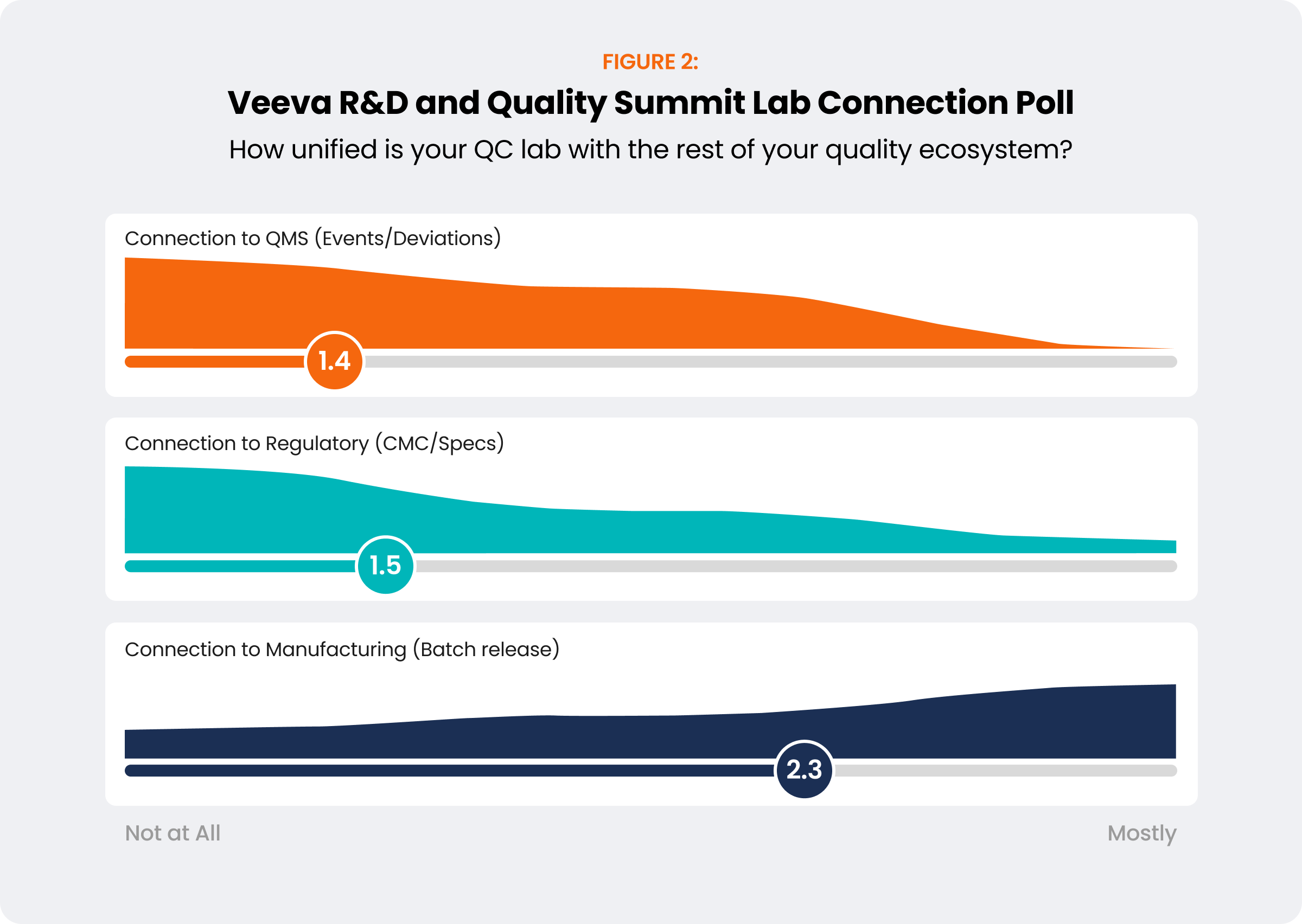
Manufacturing is a priority as biopharmas work to connect their QC labs to adjoining areas of the business. Once a batch is verifiably safe and compliant, strong integration between these areas accelerates the release of product to customers.
But the ability to respond cross-functionally if things go wrong also warrants attention. Lower levels of integration with QMS processes, and the lack of a unified QC-QA environment, mean lab teams are finding it more onerous than they should to trigger events and deviations, and subsequently collaborate with other quality stakeholders to close them out. This silo slows remediation and ultimately batch release, holding QC labs back from their full potential as the engine of a proactive and connected quality ecosystem.
Lab 4.0 transformation faces significant hurdles
Quality leaders identify the biggest barriers to basic lab digitization as:
- Lack of standardized processes
- The wide range of physical lab equipment that complicates validation, maintenance, and integration requirements
When aiming for the advanced future state of “Lab 4.0”, more barriers emerge:
- Budget/resource constraints: This encompasses a lack of acquisition budget, and the perceived lack of ROI from lab transformation. Because QC has long been viewed as a compliance-focused cost center, labs have typically seen lower levels of capital investment than R&D or manufacturing.
- Cultural inertia: Attendees note that the mindset of “this is how we’ve always done it” remains a significant hurdle. Legacy systems, operated with perpetual licenses purchased 10 to 15 years ago, are perceived to represent the “easy” option because the total cost of ownership is often hidden.
- Technical complexity of current systems: With disconnected on-premises systems, scaling or making multi-site changes becomes prohibitively risky, expensive, and onerous.
- Lack of unified platform strategy: Organizations aren’t building a cohesive approach to unify QC, QA, and training activities. Some participants assume investments in quality assurance won’t translate to the lab.
Building the modern lab with LIMS best practice
These challenges mirror the broader industry trends that have driven the Veeva LIMS application roadmap.
Users access a purpose-built LIMS application and replace paper with streamlined, digital QC workflows in a cloud-based environment that’s scalable across multiple sites.
It isn’t just about digitization for its own sake. Leaders are plugging their QC lab processes, content, and data into a unified quality infrastructure that enables cross-functional visibility when:
- Verifying user qualifications in Veeva Training
- Displaying SOPs and work instructions using Veeva QualityDocs
- Initiating quality events directly in Veeva QMS
- Aggregating batch data and pushing it to Veeva Batch Release for rapid disposition
This new model — without the manual stitching of unscalable on-premises and paper systems — is empowering industry leaders to rethink the scope and role of their QC labs.
Preparing for the lab of the future
Biopharma leaders are managing QC labs built upon disconnected data streams that demand high levels of manual work.
Companies advancing rapidly are successfully repositioning the QC lab as a strategic function to secure budget and overcome cultural resistance. Instead of digitizing labs in isolation, they are maximizing the value of their QC labs by working with LIMS partners who specialize in cloud-based, business-wide quality transformation.
The impact of lab modernization is clear and measurable, but the journey toward Lab 4.0 isn’t just about leaving behind paper. It’s about building a unified strategy that scales with the business, minimizes the manual touchpoints that slow down lab velocity, and integrates QC labs into a connected quality ecosystem.
Learn more about integrating LIMS technology into a unified quality approach