Veeva Quality Content Reference Model
Built on best practices, the Veeva Quality Content Reference Model helps companies modernize quality systems and harmonize processes across GxPs.
Standardizing Content Management Across the Life Sciences Industry
Historically, establishing a quality document management system in the life sciences industry required extensive requirements definition, tailored configuration, and complex validation efforts. Most of this was due to lack of standardized best practices and industry-focused innovation. Managing GxP content in legacy systems, across distinct regional sites and functional areas, naturally led to operational silos and varying document practices.
To support operational efficiency and continuous improvement across the industry, Veeva developed a standardized approach to quality content management, combining unified cloud technology with proven operational frameworks.
The approach was designed to accelerate system implementation and drive industry-wide consistency by:
- Connecting clinical, regulatory, quality, and safety applications on a common cloud platform
- Delivering built-in practices as part of business applications
- Providing continuous innovation through three scheduled releases per year
This approach has helped more than 500 life sciences companies consolidate GxP and corporate governance content and best practices in Veeva QualityDocs, a modern content management application.
To support further standardization across the industry, Veeva has published these best practices in its Quality Reference Model, publicly available to any life sciences company looking to modernize its content management approach. The Model provides a starting point for quality and document teams to align stakeholders across various business functions and create a strong foundation for harmonization across GxP content and processes.
This whitepaper provides an overview of the Reference Model and explains the benefits of leveraging standardized best practices.
How Does Standardization Help?
Establishing document hierarchy, taxonomy, and metadata is the foundation of a well- designed content management system. However, without a standardized, best practice model, it represents one of the most complex and time-consuming challenges for life science teams — often resulting in inconsistent taxonomy despite best efforts.
The Reference Model provides standardized hierarchy, taxonomy, and metadata for organizing and processing quality documentation across GxP domains. This allows end users to search for, navigate through, and locate documents quickly and easily, enhancing audit readiness and day-to-day work. The Model incorporates Veeva’s collaborative learnings from deploying content management applications for hundreds of life sciences organizations, from emerging biotechs to large biopharmas.
Benefits Beyond Speed of Search and Navigation
In addition to enhancing user experience, the Reference Model serves as a starting point for companies to gain stakeholder alignment on their overall document structure and taxonomy before implementing a content management system. The Veeva Quality Reference Model enables organizations to:
- Accelerate system implementation by avoiding roadblocks that can occur due to misalignment across business functions (including the consideration for variability across GxP disciplines, business units, and regional requirements)
- Reduce deployment and maintenance costs by streamlining configuration and validation through proven strategies and repeatable deliverables
- Improve quality and compliance by keeping the processing and organization of documents simple and consistent
- Increase system adoption through training and user-friendly capabilities, enabling users to access the right information at the right time
- Increase collaboration by streamlining information exchange across external partners and the extended supply chain
- Simplify content migration and consolidation during quality transformation efforts and mergers and acquisitions
- Drive continuous improvement through best practices gathered with each engagement
The Elements of the Quality Reference Model
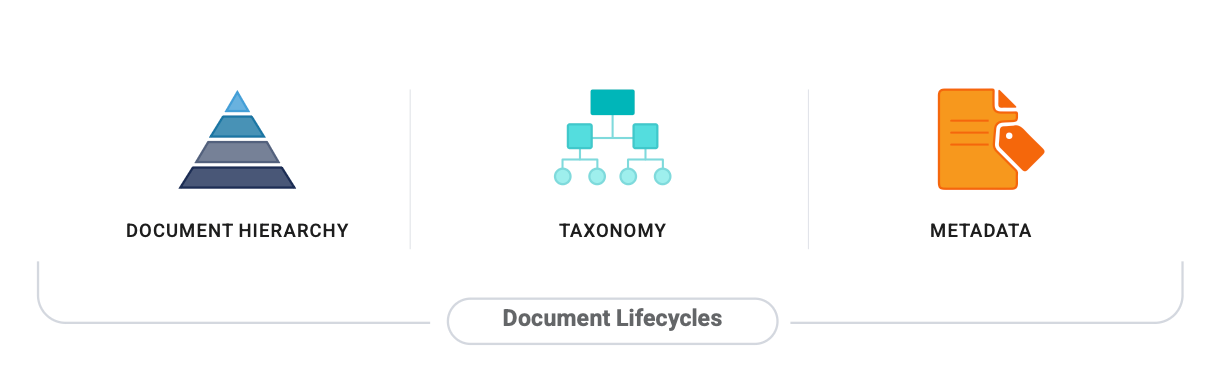
Document Hierarchy
The Model includes a document hierarchy that spans across the organization. It is broken down into four levels, from the most general at the top to the most specific at the bottom, to show how high-level policies flow down to detailed instructions and the records that prove they were followed.
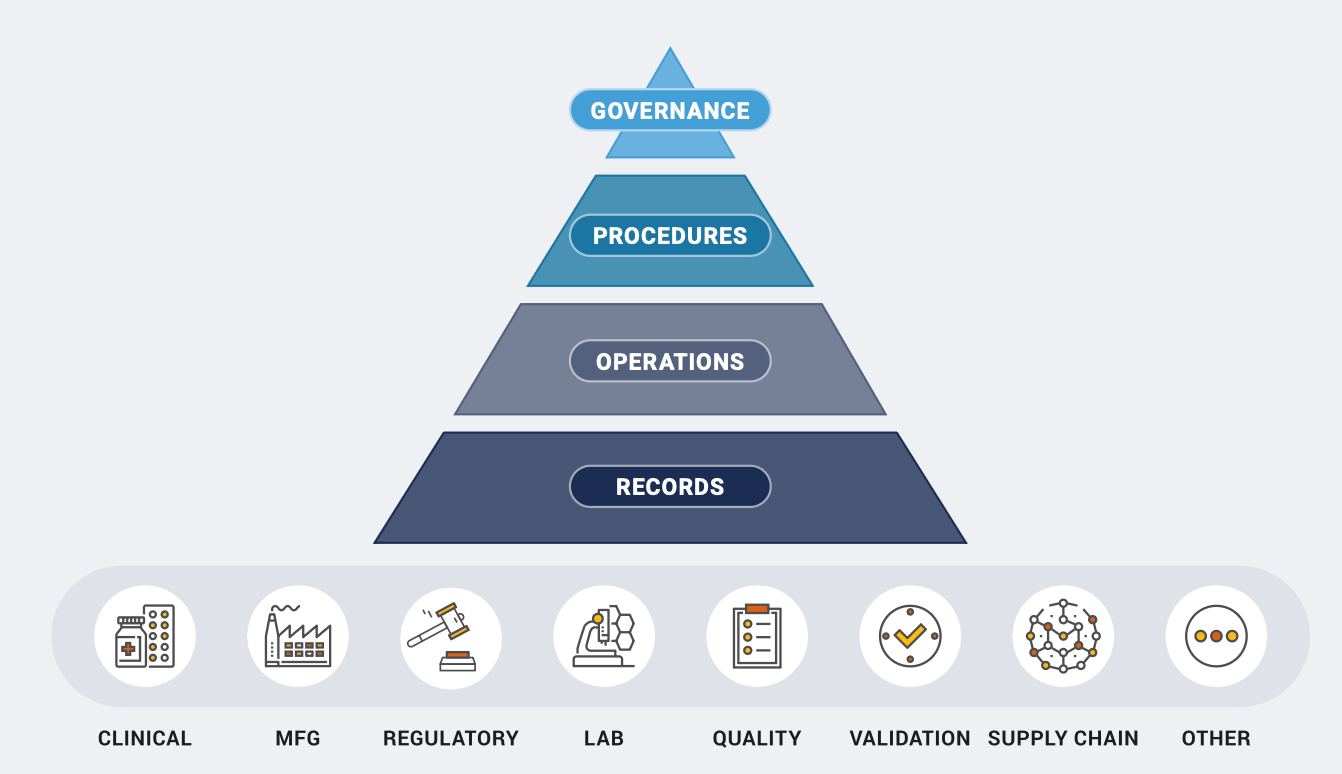
These levels, or Types, offer the highest level of categorization for an organization’s documents and lay the foundation for the Reference Model.
Below are the four Types included in the Reference Model, their purpose, and what each Type includes:
| Governance | Provides the WHY | High-level rules like Policies and the Quality Manual |
| Procedures | Provides WHAT, WHEN, and WHO | Steps to follow the rules like SOPs and Methods |
| Operations | Provides the HOW | Detailed tools like Job Aids, Templates, and Plans |
| Records | Provides the EVIDENCE | Proof that work was done, like Reports and Memos |
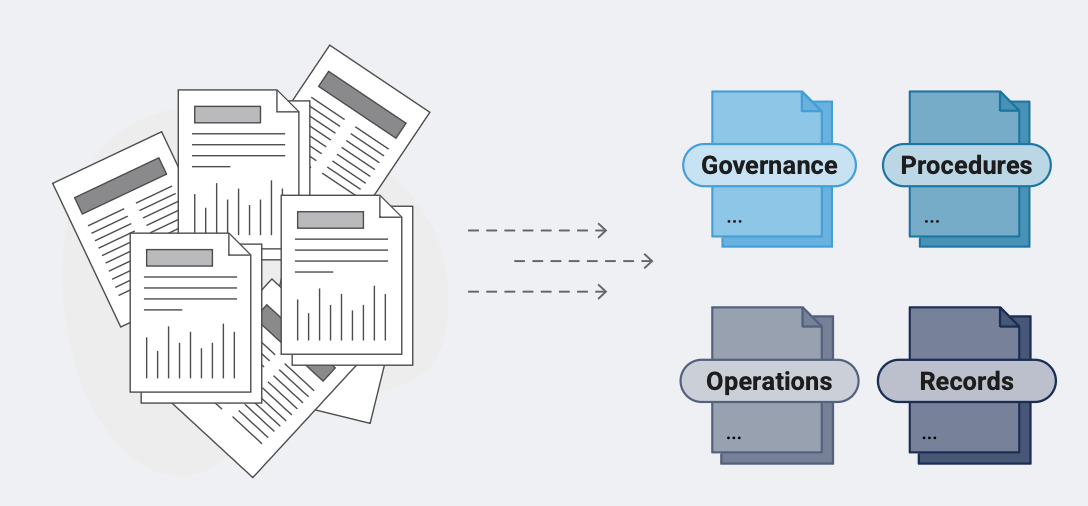
This standardized grouping of Types streamlines document mapping, eliminates redundant documents, and drives easy adoption. Any life sciences company can streamline its quality system document setup with this high-level structure.
Taxonomy
Taxonomy refers to the hierarchical classification and naming convention used to categorize documents within the Document Hierarchy. Subtypes and Classifications provide more detailed level categorization, while strengthening the integration of QualityDocs with other Veeva applications, such as Veeva RIM.
Below is the breakdown of Subtypes and Classification by Type.
Governance
All documentation which provides governing principles and defines the WHY is placed under Governance. They help organizations ensure regulatory compliance and provide evidence of conformity.Documents in this category require training and a periodic review to ensure compliance. They start in the Draft state and end in the Effective state until they become obsolete. The Subtypes under the Governance category are:
| Policy | Describes a company’s intentions, direction towards meeting requirements, and facilitates the development of objectives. |
| Quality Manual | Describes a company’s position or approach toward quality. |
| Standard | Provides the industry and regulatory requirements (the ‘what’). |
| Site Master File | A high-level document that provides a detailed overview of a specific manufacturing site. |
Procedures
Procedures are those documents which represent the definitive instructions for repeatable success. They translate regulatory expectations (from the Governance level) into explicit, step by-step actions. Their primary purpose is to eliminate variability, ensuring that, whether a scientist is running an assay or an operator is executing a manufacturing run, a process is performed identically every single time.
Most documents in this category require training and a periodic review to ensure compliance. The Subtypes under the Procedures category include:
| Standard Operating Procedure | A formal, controlled document that provides detailed, step-by-step instructions on how to perform a routine activity. |
| Method | Contains detailed step-by-step instructions for performing a test. There are 2 classifications for Method — Analytical and Test. |
| Protocol | Specifies critical steps for conducting activities and their acceptance criteria. A protocol is approved before an activity begins. There are several classifications for Protocol including Clinical, Stability, Transfer, Comparability, Method Validation, Equipment Validation, Cleaning Validation, Process Validation, Environmental Monitoring, Computer System Validation. |
| Master Batch | Record Provides the “recipe” for manufacturing a product. |
Operations
Documents in the Operations category represent the operational infrastructure and execution tools of the organization. While the Procedures level dictates how to perform a process, the Operations level translates procedural theory into tangible practice by providing the strict technical criteria, risk guardrails, external alignment agreements, and data-capture templates necessary to execute daily operations.
Most documents in this category do not require training or periodic review.
The Subtypes under the Operations category are:
| Agreement | A negotiated arrangement between parties that outlines requirements and expectations. There are 3 classifications for Agreements—Quality, Service, and Technical. |
| Assessment | Identifies and evaluates potential risks, evaluates suitability and whether the assessment meets requirements and expectations, and documents the outcome of the assessment activity. |
| Certificate | Attests to a status or achievement level for a system or a process. There are several classifications for Certificate including Analysis, Conformance, Packaging, Supplier, and Sterility. |
| Form | A starting point for a new form. It includes predefined fields for consistent collection of data or information. |
| Guide | Document that provides interpretations, best practices, and recommendations on how to comply with high-level regulations. |
| Job Aid | A specialized controlled document designed to provide quick, "at-a-glance" support for a specific task. |
| Logbook | A controlled record used to document the chronological history of a specific asset, room, or process. |
| Plan | A high-level, controlled document that defines the strategy, scope, resources, and specific activities required to achieve a major objective or meet a regulatory requirement. |
| Safety Data Sheet | A detailed, standardized document that provides comprehensive information about a chemical substance or mixture regarding its hazards, handling, storage, and emergency measures. |
| Specification | Identifies and establishes conformance requirements or criteria for a material, product, or system to be considered acceptable for its intended use. Specification has many Classifications, including In-Process, Packaging, Raw Material, Release, Comparator. |
| Template | A starting point for a new document. It includes predefined fields for consistent collection of data or information. |
| Training Material | Documents or content used for learning and development. |
| Work Instruction | Provides information to assist a user in performing a specific task or activity. |
Records
Occupying the foundational base of the document hierarchy, the Records level represents historical evidence, truth, and definitive proof of compliance within the organization. While the levels dictate what should happen (Governance), how it should happen (Procedures), and provide the tools to do it (Operations), the Records level captures exactly what actually happened. In the eyes of regulatory bodies like the FDA or EMA, if it wasn't recorded, it didn't happen.
The Subtypes under the Records Types include:
| Batch Record | A collection of documents for a specific production run (batch) of a product that captures every manufacturing, packaging, cleaning and testing step including who did it, when it happened, which materials were used, and the results obtained. |
| Executed Record | Documents that are executed and completed externally and then stored in the system as a record. |
| Electronic Executed Form | Uses a Form as a starting point. Downloaded, populated electronically, and then routed within the Vault application for review and approval. |
| Memo | A controlled document used to provide clarification, record a specific one-time event, or offer a scientific justification for a decision that isn't captured elsewhere in the formal Quality Management System. |
| Paper Executed Form | Executed outside the system then housed back in the system as a document of reference. Created from a Master Form. |
| Report | A formal, controlled document that summarizes the results, analysis, and conclusions of a specific activity, experiment, or investigation. It provides evidence of what happened and what the data means. Report has several classifications, including Annual Product Review, Clinical, Transfer, Stability, Cleaning Validation, Process Validation |
| Validation | Documents used to provide evidence or verification of system/equipment validation |
Metadata
Metadata fields ensure the system stays organized. It allows end users to search, navigate, and locate exact files quickly, while preventing employees from having to wade through irrelevant documents to find the information required to do their jobs. Having the right metadata fields in place removes the need to embed technical traits into document Types, preventing the reference model from becoming overly complex, and keeping document Type names short and manageable.Below are examples of metadata fields included in QualityDocs:
| Impacted Department | Internal department that may be impacted by the details of the document. |
| GxP? | A Yes/No field indicating if the document is GxP. |
| External? | A Yes/No field indicating if the document is used externally. |
| Document Supplier | The external business entity, vendor, contract organization or third-party service provider that is associated with the document. |
| Process | Categorizes content by the business activity it enables. |
Document Lifecycles
Each document in a quality document management system has a lifecycle governed by industry regulations like 21 CFR Parts 210 and 211. All documents outlined in the Reference Model follow one of the following lifecycles:| Draft to Effective | Documents that follow the Draft to Effective life cycle start in the Draft state and end in the Effective state (steady state). These documents usually require training and have periodic reviews associated with them. Over time, documents in this life cycle will transition to Obsolete when they are no longer valid for use. |
| Draft to Approved | Documents that follow the Draft to Approve life cycle start in the Draft state and end in the Approved state (steady state). Over time, documents in this life cycle will transition to Obsolete when they are no longer valid for use. |
| Initial to Final | Documents that follow the Initial to Final life cycle start in the Initial state and end in the Final state (steady state). This life cycle is mostly used for Documents of record (i.e., executed batch record), where no versioning is required. |
Each lifecycle includes workflows that determine how the documents are processed as they move from the starting state to the steady state. Standardized workflows accelerate review and approval processes, and streamline SOPs and other GxP document sharing among stakeholders.
Standardizing Document Management Across the Enterprise
Standardizing and simplifying quality document management across the enterprise is fundamental to a robust quality system. A standardized document structure and nomenclature based on industry best practices accelerates system implementation, improves system usability, and simplifies overall document management.
Based on industry best practices, the Veeva Quality Content Reference Model provides a simple framework that can save months of effort defining document hierarchy and taxonomy, accelerating the implementation process.
Access the Reference Model and use it as a starting point for a compliant, easy-to-use quality document management system.