The Field Force Reimagined
Commercial Evidence™ transforms the field force and improves ROI.
by Aaron Bean & Nicson White
A commercial model built for a different era
Historically, biopharma field forces focused on healthcare professional (HCP) access. ROI depended on coverage and frequency: more visits meant more prescriptions.
However, the time available for meaningful exchange is compressing dramatically, diminishing the returns of the traditional, promotional push model. With fewer opportunities for HCP access, impact drives ROI rather than scale.
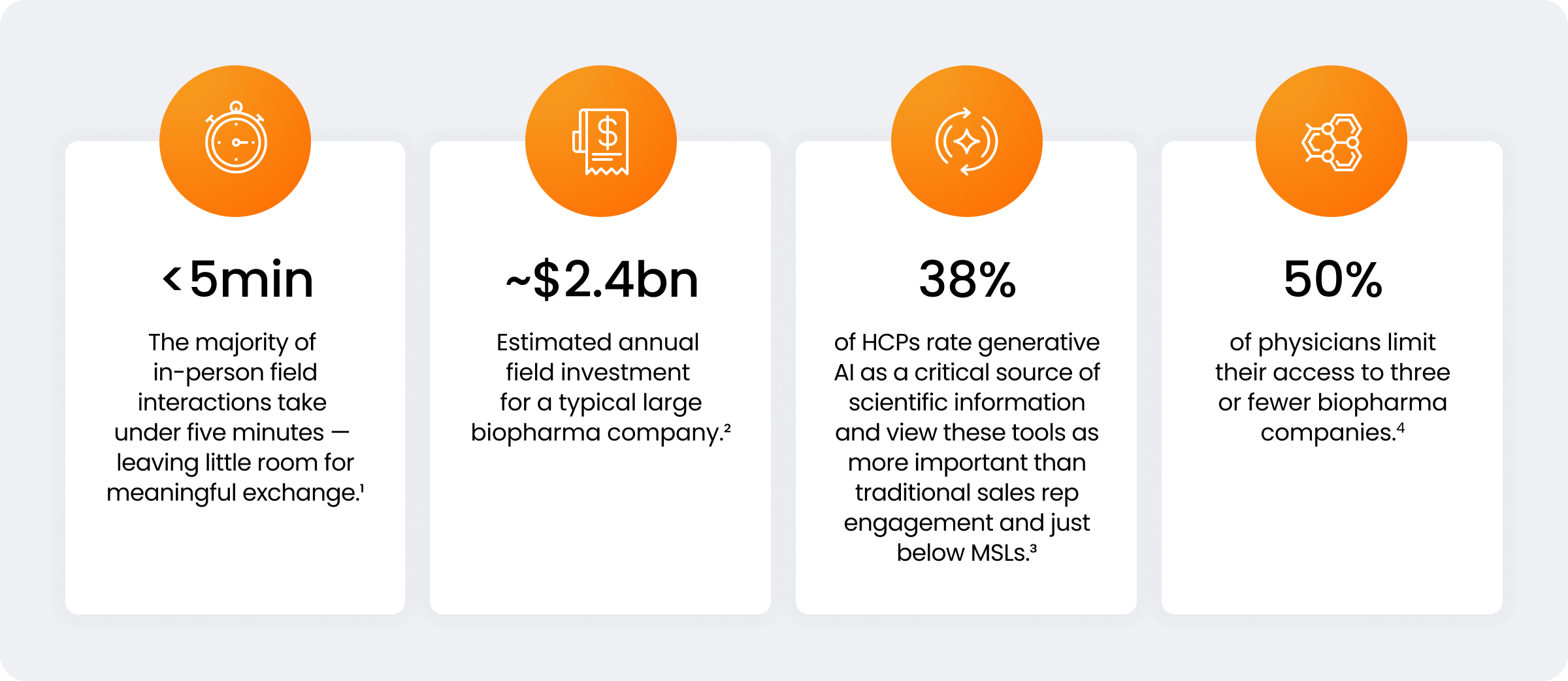
With ROI under scrutiny as field investment increases, the question facing every commercial leader is no longer how to optimize the existing model, but whether the existing model is still the right one.
The hidden asset nobody was measuring
Field reps represent a highly qualified, proximate yet under tapped, market research function in biopharma. Every day they engage with HCPs and non-clinical influencers to gather insights that standard surveys, claims datasets, or CRM drop down lists miss.
They learn which physicians are enthusiastic and which are politely dismissive. They learn which objections are clinical and which are systemic. They learn who the key account influencers are and what dynamics exist among them. They learn when a payer changes a pathway before that change appears in any data feed. They learn which messages land and which fall flat.
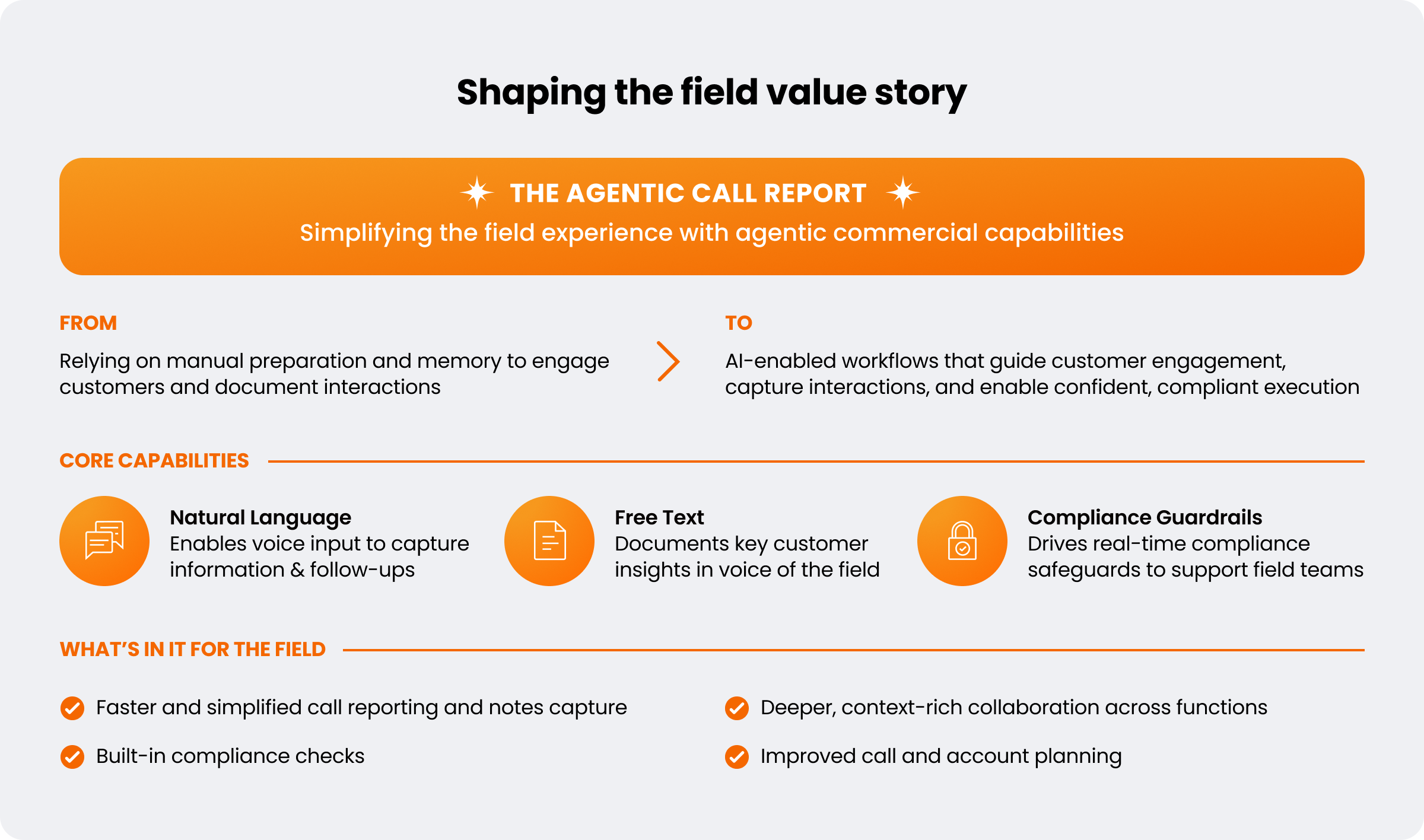
Until now, that intelligence evaporated because the data was too unstructured to process, too subjective to trust, and too voluminous to review manually. Commercial Evidence, powered by Agentic Call Report capabilities, addresses all three constraints simultaneously. By combining natural language voice input, free-text capture, and real-time compliance guardrails, sales reps compliantly capture interaction details that previously went unrecorded — simplifying the rep experience while deepening context-rich collaboration across functions.
Why the economics change
The insights that Commercial Evidence measures define the financial case for a reimagined field force.
Accelerating the path to peak sales
Commercial Evidence can accelerate launch performance to reach peak sales 10% faster. Barrier identification is the primary mechanism to reduce time to peak sales. Rather than discovering a key insight from sales data analysis 8-12 weeks after an interaction, such as a formulary restriction slowing adoption, Commercial Evidence surfaces it within days. Brand teams can respond, access teams can engage, and the window of lost revenue closes.
Increasing call quality
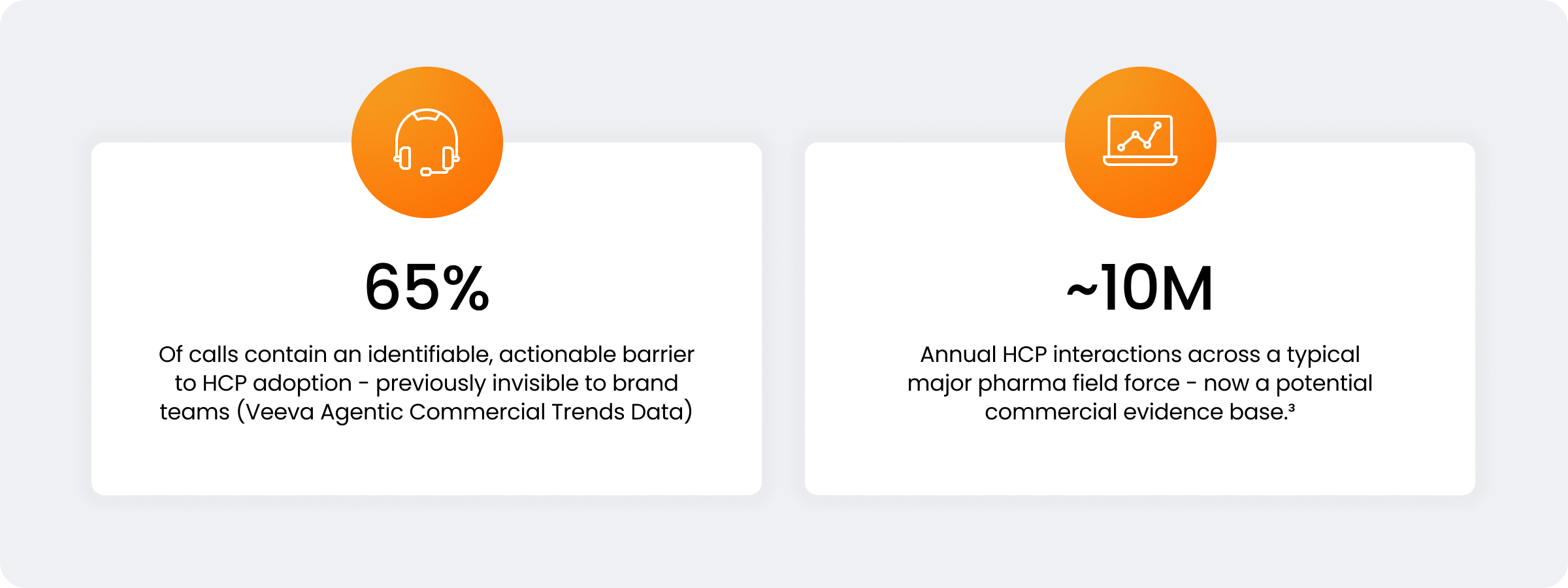
If 65% of calls contain an actionable treatment barrier today, and the home office captures and resolves these barriers systematically, the next interaction with that physician is qualitatively different. The rep has the knowledge of what blocked the last conversation, what the physician’s adoption stage is, and what scientific evidence or action is needed to progress them.
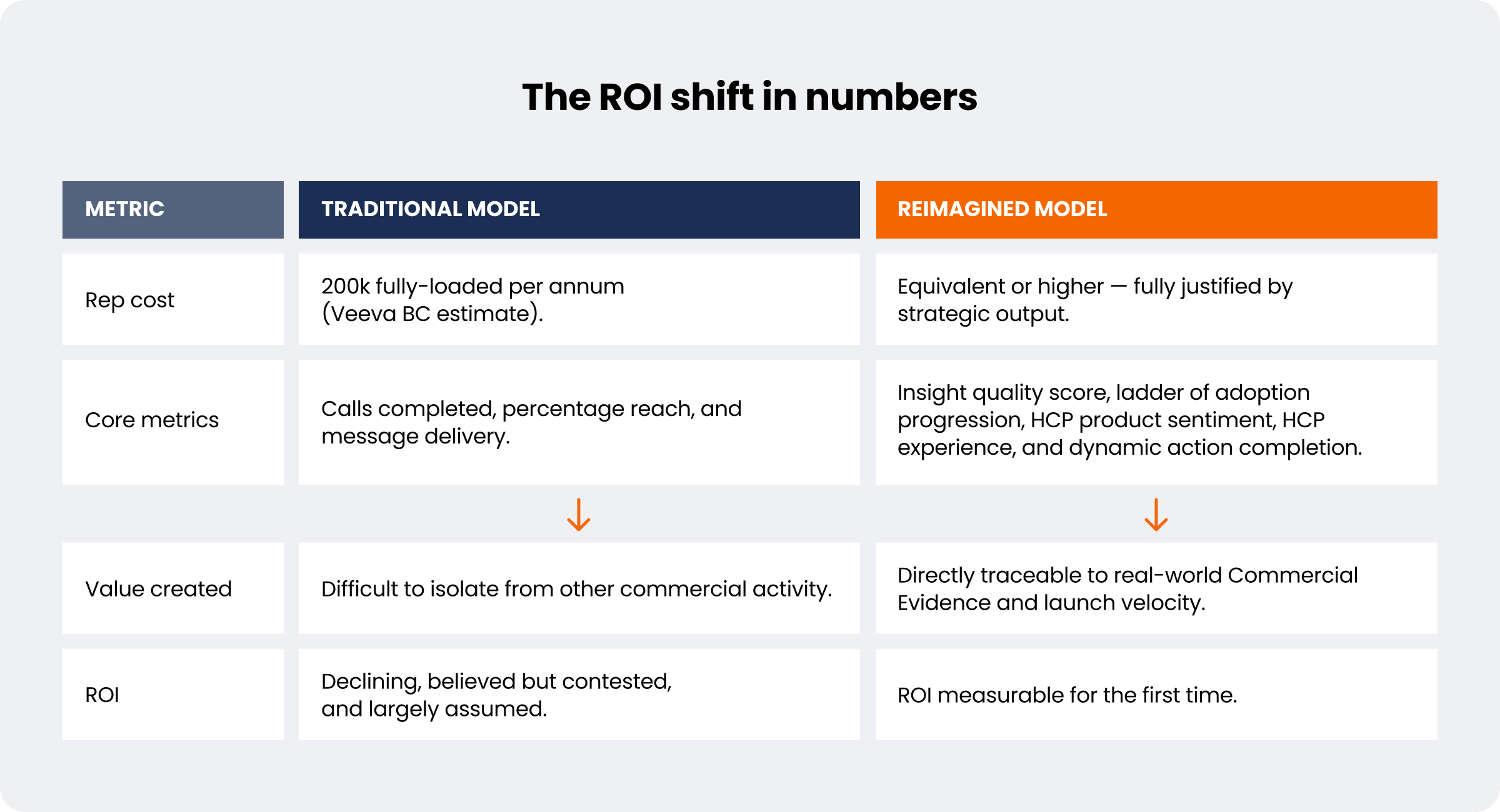
This redefines the optimal field force model. Fewer, higher quality interactions, guided by precise pre-call intelligence, outperform a high-volume reach-and-frequency approach. The implication is not necessarily a smaller field team — it is a field force that justifies its cost through demonstrable adoption progression rather than call activity.
The long-term commercial impact
- Barrier resolution value: Resolving just 30% of identified treatment barriers six weeks earlier generates three to five additional patient starts per barrier. Across a product launch, this is how commercial teams achieve faster speed to peak sales, delivering measurable revenue impact.
- Intelligence platform value: Beyond individual brand returns, a field force that generates structured commercial evidence across a portfolio builds a proprietary intelligence advantage. This real-world context directly improves brand planning, medical affairs strategy, market access negotiations, launch sequencing, and patient retention strategy.
Improving HCP access
When sales reps move away from promotional messages to serve HCPs as informed, consultative partners — armed with knowledge of what the physician said last time, what is blocking their patients, and what evidence or action would help — the relationship changes.
The most consistent reason HCPs restrict or close access to biopharma field teams is the perception that interactions are repetitive, low-value, and one-directional. EPG Health data shows that roughly 80% of HCPs want to interact with a biopharma organization twice per month at most, with half of those desiring less than monthly contact. Conversational AI and GenAI LLMs are increasingly answering specific questions HCPs have about products, but the true value of the reimagined field team emerges when the need goes beyond just providing information. A rep who knows the physician’s specific concerns and issues, can not only reference a prior conversation meaningfully, but also bring a targeted clinical or practical solution as well, offering qualitatively different value than a traditional visit.
Veeva data shows that 50% of accessible HCPs restrict engagement to three or fewer companies — meaning access is not just declining in volume but consolidating around the companies that HCPs find most valuable. Commercial Evidence favorably accelerates that consolidation. Reps who demonstrate genuine continuity of understanding, problem-solving intent, and responsiveness to what physicians raise are those who retain and deepen access over time.
Historically, clinical complexity limited sales reps to carrying one or two products at a time — a model that resulted in multiple reps reaching the same HCP, thus increasing commercial costs and overwhelming HCPs. Under the Agentic Commercial Model™, reps leverage AI-powered Media Search to instantly reference product content and data on demand while generating Commercial Evidence by capturing HCP feedback through Agentic Call Report. Consequently, fewer individual reps visit each HCP, optimizing territory coverage and delivering a better customer experience.
Driving field behavior shifts
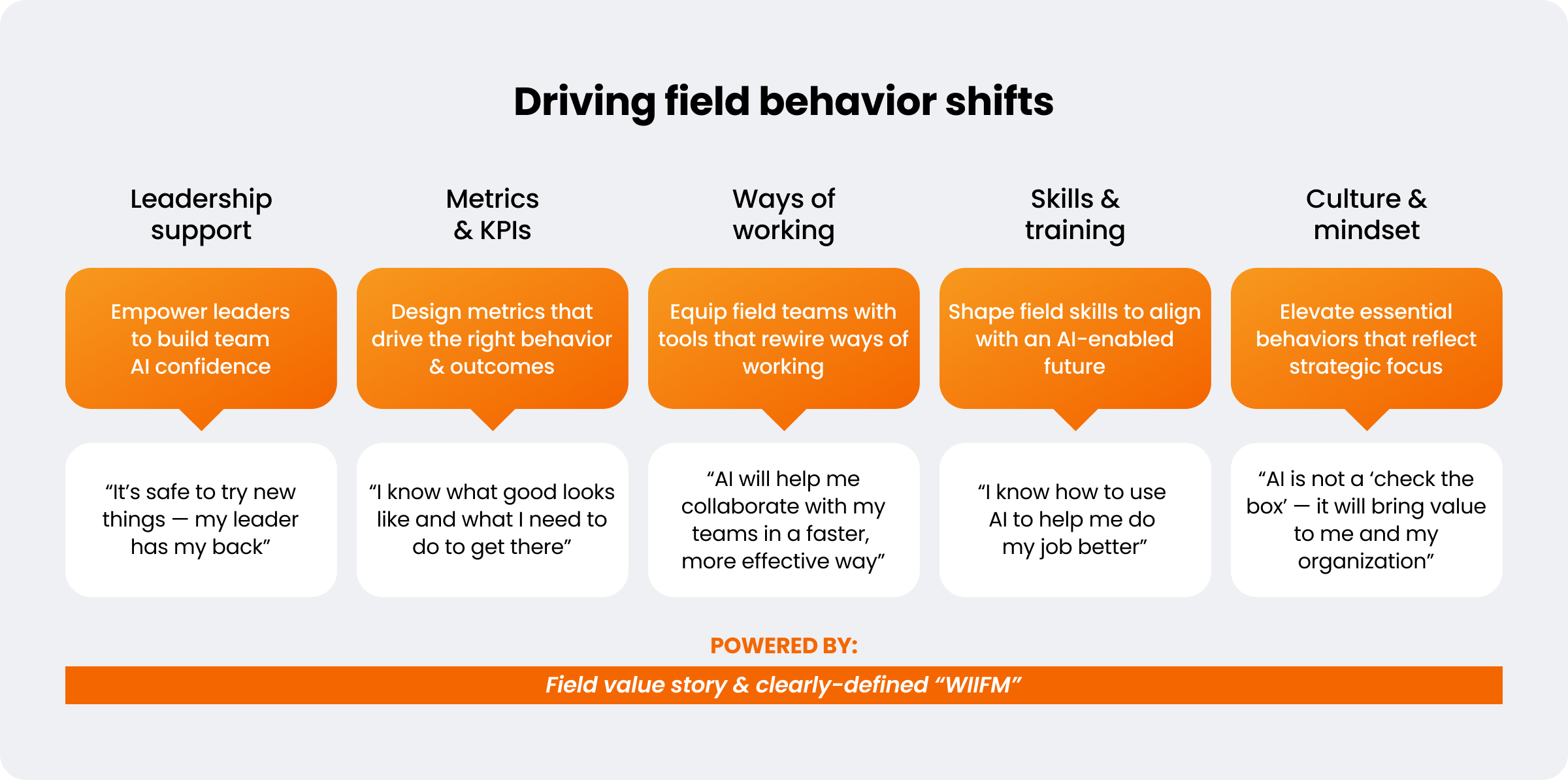
Evolving from a promotional push to an insight-driven model requires aligning technology with human execution. Commercial and medical teams drive this behavioral shift across five core pillars: leadership support, metrics and KPIs, ways of working, skills and training, and culture and mindset.
Anchoring these five pillars to a clear field value story — and a manager-led strategy that tackles the perceived threat of change — ensures the field experiences faster call reporting, built-in compliance checks, improved account planning, and deeper collaboration across functions.
Aligning the incentive model
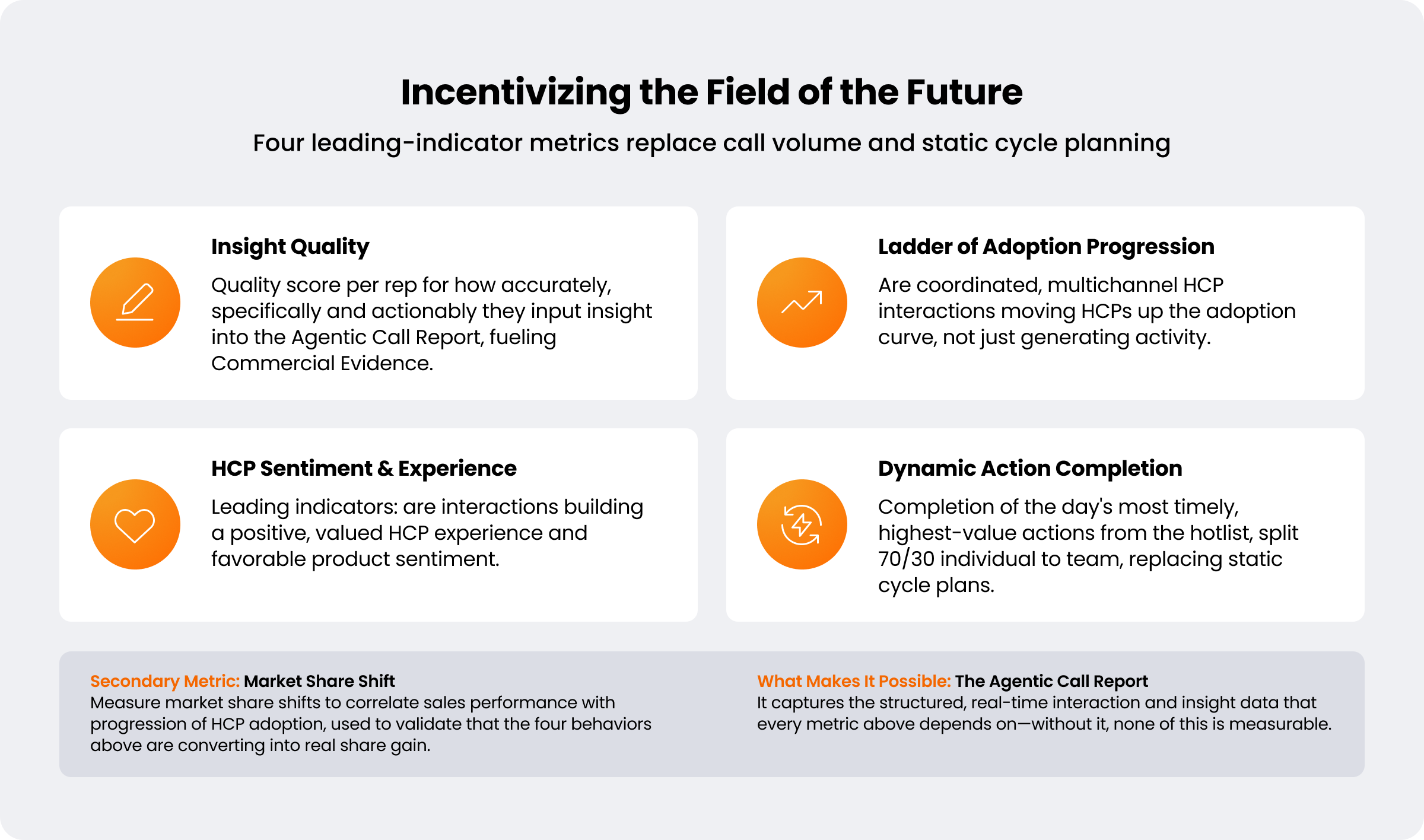
Taking sales as an example, as the sales force evolves from a purely promotional function into a source of Commercial Evidence, the incentive model needs to evolve with it. Compensating reps on prescription volume alone — a lagging indicator they cannot directly control — is increasingly inconsistent with customer experience goals. It incentivizes activity over quality, volume over insight, and call completion over call value.
Commercial Evidence introduces four scalable metrics to modernize performance tracking. Anchoring the next generation of incentive design to these metrics drives the rep behavior change that supports an insights-driven commercial strategy.
Is it now worth investing more in the field?
If the field force is generating structured, AI-analyzed Commercial Evidence that feeds brand strategy, market access, medical, and field orchestration simultaneously, economic contribution extends far beyond direct prescription conversions. Commercial Evidence transforms CRM into an intelligence platform, delivering returns across the organization and product portfolio.
With that context, the right question is not “how do we reduce field force costs?” It is “how do we maximize the return on the field force investment by ensuring every interaction generates maximum intelligence value?”
That might mean investing in better field team member selection and calibrating for insight generation as much as relationship management. It might mean smaller, higher quality field forces with more time per interaction. It almost certainly means investing in the technology infrastructure with voice capture, conversational AI, and quality scoring that converts field conversations into Commercial Evidence.
The brands that answer this question first — and redesign their field model around Commercial Evidence generation as well as promotional execution — will build a compounding advantage that is very hard for competitors to replicate.
- Assess your current commercial evidence baseline: what percentage of field intelligence is currently captured in a form your brand teams can act on?
- Model the revenue impact of 6-week earlier barrier identification on your priority launch
- Review your current field incentive frameworks: does it reward activity or outcomes? What would it take to shift 20% of incentive weighting to insight quality and adoption progression?
- Identify two or three field-force leaders who would champion a commercial evidence pilot — early adopter momentum is the single most important factor in successful adoption.
Contact Veeva Business Consulting to understand what a structured assessment of your field force ROI opportunity looks like.
1 Veeva Pulse Field Trends Report, Europe Q2 2024. EU5 in-person interaction duration data.
2 Veeva Business Consulting estimate. ~16,000 customer-facing people x $150k fully-loaded cost = ~$2.4bn. Interaction volume: 3 calls/day x 210 field days = ~10M annual HCP interactions across a universe of 1-3M HCPs.
3 The evolution of pharma engagement as AI becomes a front door to medical information.
4 Veeva Pulse Field Trends Report.