Blog
Evolving from Document Management to Strategic Safety Management
Sep 09, 2026 | David Kolosic
Sep 09, 2026 | David Kolosic
Creating the foundation for AI, operational excellence, and strategic pharmacovigilance
As pharmacovigilance (PV) teams strive to increase their value as strategic partners to the organization, safety documents can no longer be managed as files for compliance. The valuable content and underlying processes are operational assets that can be used to drive pharmacovigilance performance — and the value is only increasing in the age of AI.
Despite rapid advancements in PV technology, the industry still has outdated approaches to managing safety documents that is driven primarily by compliance requirements. Teams often think of safety documents first, and the underlying processes and data in those documents second.
This made sense when the goal was simply document storage. SharePoint, point solutions, or storing documents in systems owned by other functions could do the job reasonably well. But with the need for safety to be a strategic partner to the business and the rapid evolution of AI, this approach is no longer efficient or effective. That’s because safety documents aren’t just documents.
The PSMF, for example, is a detailed collection of processes, content, and data that outline a sponsor’s entire safety system. Required by the European Medicines Agency (EMA) and other global health authorities, a complete and up-to-date PSMF must typically be produced within seven days of a regulatory request. Managing these safety documents in disparate general-purpose systems creates a loss of oversight, version control challenges, significant manual effort to verify content is current, and often requires complex customizations.
Modernizing the approach from safety content to safety management can drive greater efficiency, improve inspection readiness, and provide immediate return on AI investments. Read on to learn why managing safety processes, content, and data together creates the foundation for AI, operational excellence, and strategic pharmacovigilance.
Hidden risks of “borrowed” systems
While it may seem efficient to use existing regulatory or quality infrastructure or applications to manage safety documents, these systems are not designed to handle the specific complexities of the safety lifecycle.
Without a purpose-built safety solution, teams face several challenges:
- Lack of direct oversight: Safety teams require direct and timely control over system configurations, processes, and documents that need frequent updates.
- Compliance gaps: Many organizations still rely on disparate, non-GxP SharePoint sites and Excel spreadsheets to store documents or track completion of activities, creating a fragmented landscape that is difficult to audit.
- Manual reconciliation: Housing documents in external systems necessitates constant manual checks between safety and regulatory or quality teams to ensure the latest versions are ready for submission. This includes manually documenting communication and hand-offs that happen outside of the system.
- Complex customization and integration: Using systems to maintain safety documents often requires expensive, complex customizations to bridge the gap between systems.
Use case highlight: PV Agreements
PVAs or Safety Data Exchange Agreements (SDEAs) outline responsibilities for PV activities between two or more parties. The expectation of the regulator is for the market authorization holder (MAH)/sponsor to be able to demonstrate that they have full control and oversight over all PV activities. On the one hand, you have the document that outlines the agreements and the parties. But on the other hand, there are all of the day-to-day activities that require frequent collaboration and real-time oversight to ensure they are completed within agreed upon timelines. Treating the document as separate from its required activities is inefficient and creates risks.
For example, tracking an obligation for signal management requires managing contacts at partner organizations, contract management, content distribution, scheduling, and other activities, as well as documenting when and how those activities took place. Storing the documents in one system while managing the process in another system — or worse, using no system at all — requires significant manual effort and reconciliation.
Figure 1: Standardizing PVA Management in a Dedicated Safety System
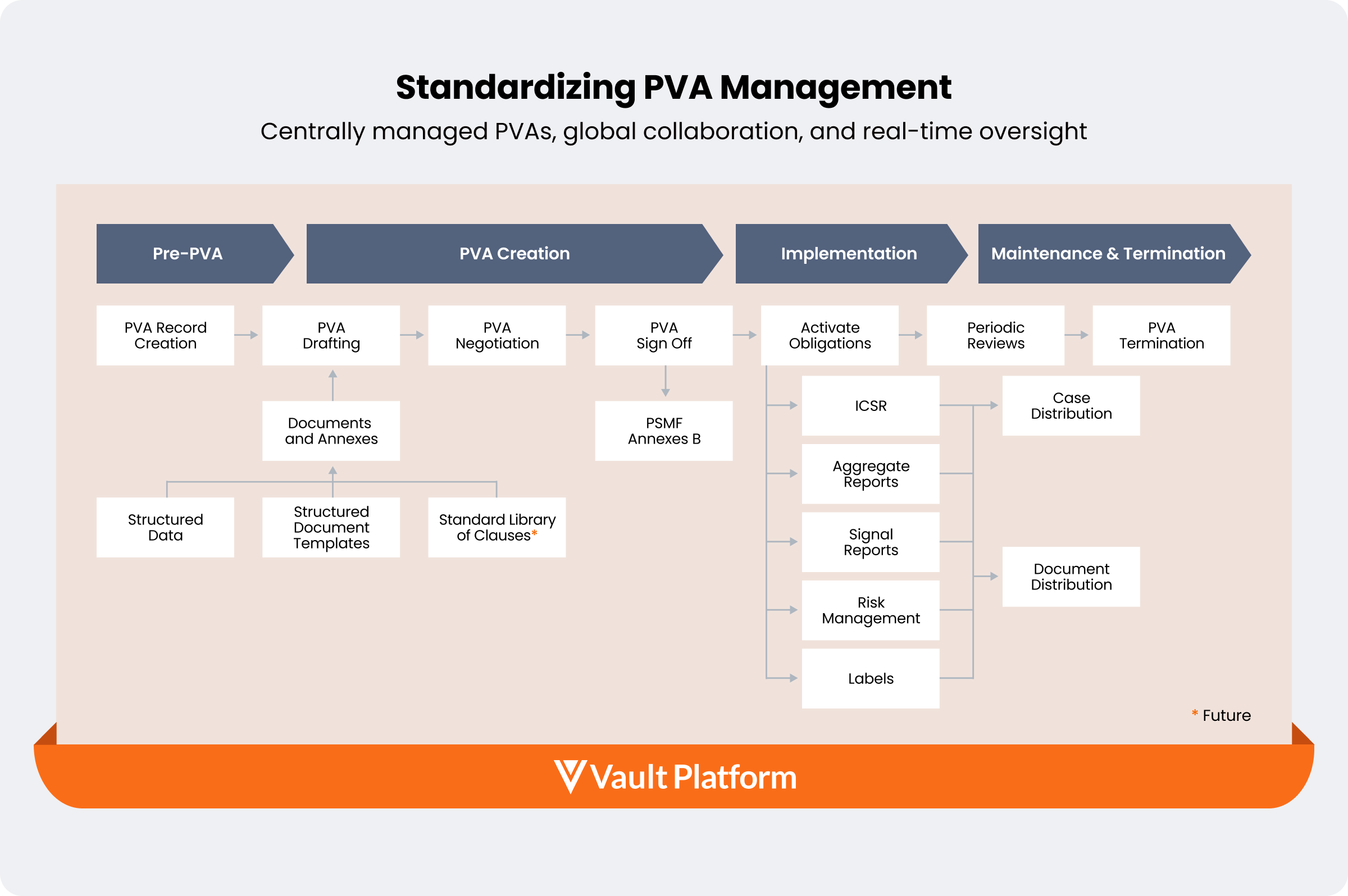
With a unified and connected safety system, PV teams can manage the PVA in one place with clear audit trails. Centralizing this process also allows the team to standardize workflows and automate scheduling and document distribution, reducing administrative work and manual reconciliation. It also creates the foundation for AI by bringing together the processes, content, and data AI needs to understand obligations, monitor activities, and assist with PV operations.
Better safety management with a centralized hub for safety processes, documents, and data
A modern solution with a centralized approach provides automation across safety processes, documents/content, and data that general purpose and siloed systems are not designed to support. This gives safety teams greater control, improving efficiency and inspection readiness. It also enables teams to collaborate across markets or regions while reducing manual effort and operational inconsistencies.
A dedicated safety system like Veeva SafetyDocs delivers “out-of-the-box” solutions for:
PSMF: Streamline global and regional PSMF management with content reuse and automated periodic reviews and annex generation.
PVAs/SDEAs: Seamlessly oversee the status of PVAs, safety data exchange agreements (SDEAs), and partner and/or service provider data obligations, and link activities to underlying commitments for easy reconciliation.
Risk management and mitigation: Author, manage, and track core and local risk management plans (RMP) and additional risk minimization measures (aRMMs). Safety teams can easily identify current plans with version management and track the implementation of aRMMs for improved oversight of compliance monitoring.
Aggregate safety reports: Controlled workflows for authoring, reviewing, and managing aggregate safety reports including automatically generating and assigning tasks. Track progress, as well as create custom data extracts, automatically run data sets, or generate customized line listings and data reports.
Signal management: Maintain Good Pharmacovigilance Practices (GVP) Module IX compliant signal management processes and workflows fully integrated with MedDRA.
Enable strategic safety and industry-specific AI
A unified, purpose-built safety system creates the foundation for strategic safety management and AI. With end-to-end ownership and control of critical safety information, PV teams gain greater visibility to improve decision-making, strengthen compliance, and leverage the safety data and operational information in new ways. These insights can support earlier signal detection, identify new therapeutic indications, and reveal opportunities to improve PV performance.
This foundation also enables deep, industry-specific AI. Safety agents can operate natively in the platform using the full context of safety processes, content, and data without relying on complex integrations or bolt-on solutions. Because agentic AI is built directly into the platform, validation effort is significantly lower than integrated AI solutions.
Increasingly, highly manually and cumbersome processes that were often outsourced will be largely — if not completely — handled by advanced automation and AI, allowing safety teams to focus on higher value work. Example use cases include:
- Reviewing PSMFs, PVAs, and RMPs for technical quality and completeness
- Extracting obligations from PVAs
- Automating PSMF logbooks and annex generation
- Identifying and summarizing aRMMs within RMPs
With automation and AI capabilities across the PV ecosystem, safety teams can greatly improve traditionally resource-intensive tasks. Bringing safety process, content, and data together creates the foundation for greater efficiency, improved inspection readiness, and return on AI investments.
Hear how OM Pharma uses Veeva SafetyDocs to manage PVAs more effectively.