Rethinking CRM in Life Sciences: From System Implementation to Value Creation
A once-in-a-decade reset moment
Used correctly, CRM can hard-wire new ways of working, reshape decision-making, and translate engagement strategy into daily execution.
Life sciences is at a crossroads. As many organizations reassess their CRM platforms, the industry has a rare opportunity to reset customer engagement. Yet, history suggests a risk that this moment is squandered — either by chasing hype that fails to deliver, or by simply replacing one system with another while behaviors, processes, and outcomes remain unchanged.
For years, organizations have treated CRM primarily as a technology decision. The results are well known: inconsistent adoption, limited insight, marginal commercial impact, and disappointing return on investment. The uncomfortable truth is this: CRM fails when generic technology creates a 'behavioral tax', forcing users into manual data entry and fragmented workflows that serve the system rather than the customer.
The critical question for leaders is: what future of engagement are you designing for?
- What capabilities do you need to compete?
- Which decisions require automation, orchestration, or guidance?
- What needs to change across sales, marketing, medical, and access to make that future real?
Technology is not the panacea. But used correctly, CRM can hard-wire new ways of working, reshape decision-making, and translate engagement strategy into daily execution. Used poorly, it becomes just another system teams tolerate rather than trust and value.
This reset moment will determine whether CRM remains a cost of doing business — or becomes a source of durable competitive advantage.
Value comes from behavior, not systems
A CRM-enabled transformation only creates value when it changes how people engage customers, make decisions, and spend their time. Value therefore comes from behavior — not technology.
This explains a familiar pattern. Systems go live. Adoption is ‘measured.’ Dashboards are built. Yet, commercial impact remains muted, inconsistent, or short-lived.
Why? Because value is not realized at go-live. Instead, organizations realize value by embedding, measuring, coaching, reinforcing, and sustaining the right behaviors. Outcomes follow behaviors and behaviors must be intentionally designed.
This paper outlines a best practice approach to CRM-driven customer transformation: one that is business-led, behavior-focused, and grounded in value creation rather than system delivery.
"Having a foundation for commercial agility and execution is crucial. Our collaboration with Veeva will provide us with technology solutions and data to enhance our agility as a company while we partner with an entity that shares our values and focuses on patients.”
The core problem: CRM is still treated as a technology program
Despite years of lessons learned, many CRM initiatives still follow outdated strategies with predictable consequences:
| OUTDATED STRATEGIES | CONSEQUENCES |
|---|---|
|
|
|
|
|
|
Critically, organizations often attempt to directly link CRM to revenue — an unrealistic and unnecessary goal. CRM does not sell products. People (and in the future AI Agents) do. The role of CRM is to shape behavior at scale.
A better starting point: Business outcomes first
High-performing organizations do not lead with technology; they lead with a fundamental question of impact: What business outcomes do we need to achieve, and what specific behaviors will deliver them?
In life sciences, the mandate is clear: Accelerate patient uptake to drive market expansion, sales growth, and sustainable profitability.
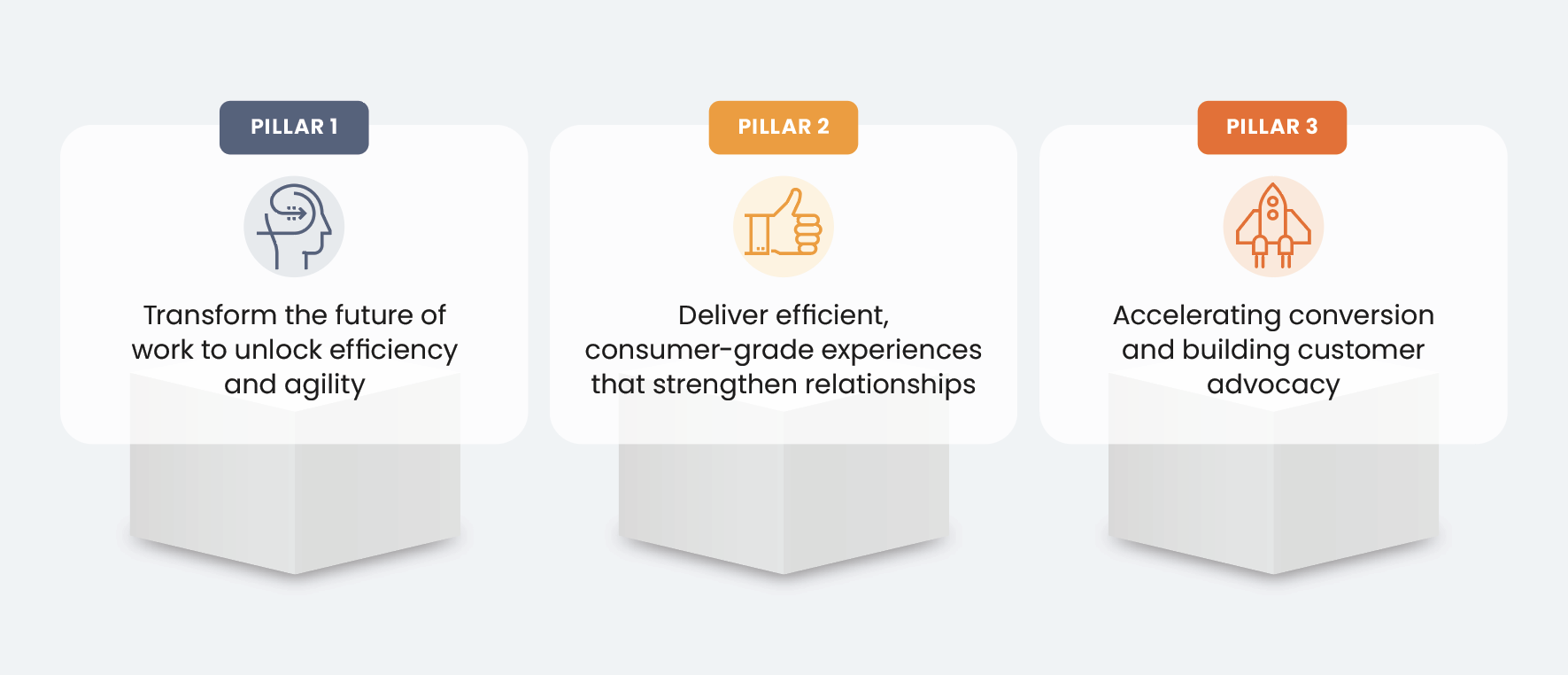
Achieving this requires moving beyond tracking system activity to engineer three pillars of strategic value:
- Transform the future of work: Unlock enterprise efficiency and agility to do more with the same or fewer resources.
- Deliver standout customer experience (CX): Forge deeper relationships through efficient, ‘consumer-grade’ experiences that resonate with modern healthcare professionals (HCPs).
- Drive market impact: Proactively accelerate conversion and cultivate long-term customer advocacy.
Figure 1: Three pillars of strategic CRM value
"Delivering outstanding customer experiences and accelerating launch processes were catalysts for us in thinking about connected engagement.”
The drivers of enterprise value
Value does not emerge from abstract intent. Instead, organizations can engineer it through six specific value drivers. These drivers translate your overarching strategy into observable, behavioral change across the organization.
Figure 2: The value driver framework
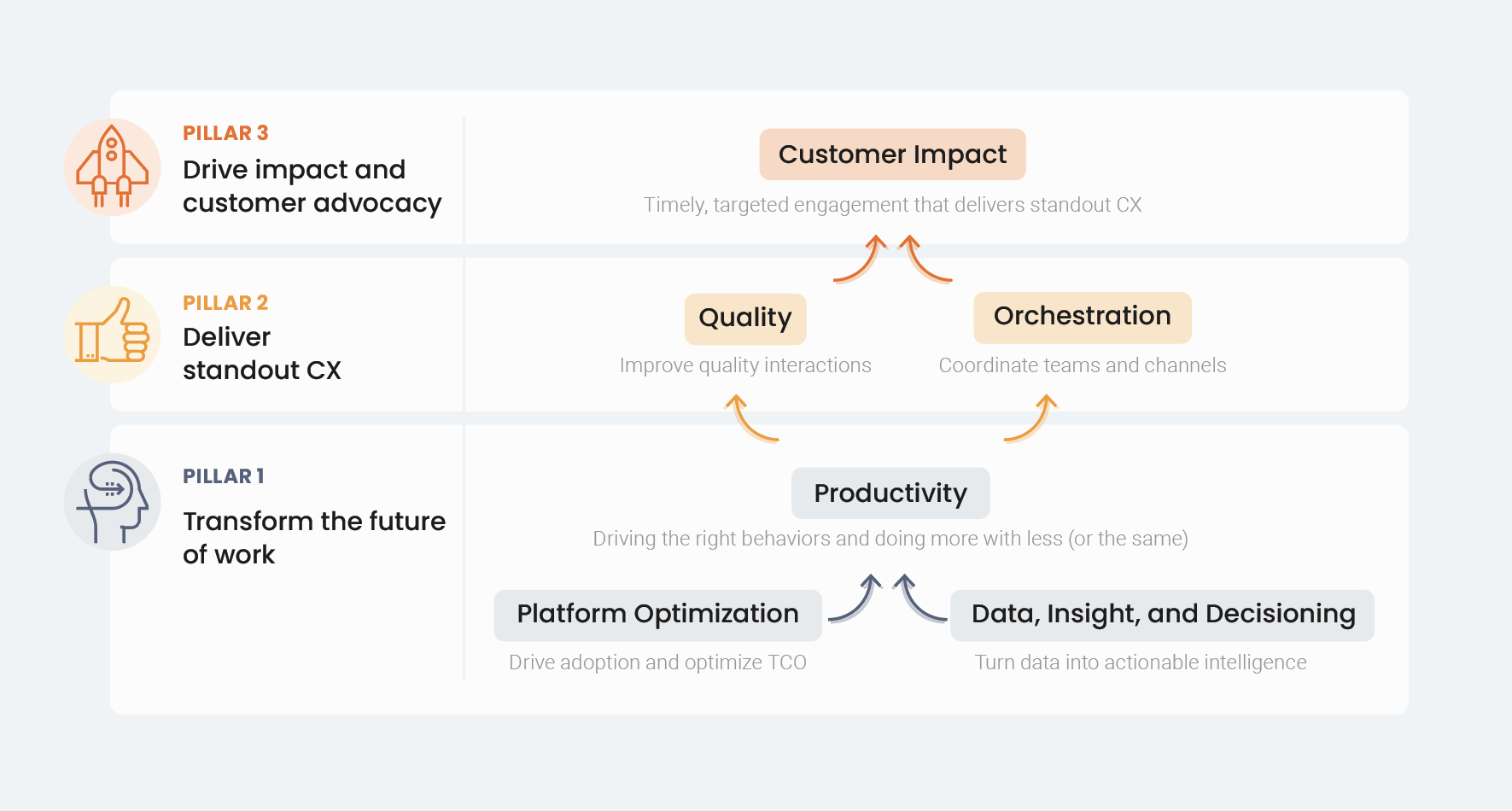
This framework functions as a strategic pyramid, engineering value from foundational capabilities upward to the ultimate commercial goal: customer advocacy. At the base, productivity and agility focus on platform optimization and turning data into actionable intelligence, ensuring the field is equipped to spend time on high-impact activities.
This operational efficiency provides the necessary capacity to ascend to the next level: delivering standout customer experience — where the focus shifts to the quality and orchestration of interactions. Finally, these optimized interactions culminate in the top-tier objective: customer conversion and advocacy — where targeted engagement directly influences clinical decision-making and accelerates product uptake.
The true power of this model lies in the discipline of measuring what matters, not what is easy. Organizations often fall into the trap of tracking ‘vanity metrics’ like login counts or total clicks simply because they are easy to extract from the system. Instead, this framework anchors each driver with 1–2 ‘killer’ business metrics linked to specific, observable behaviors. For example:
- Ladder of adoption progression measures customer impact.
- Relationship quality and customer sentiment (NPS) define quality, not just call volume.
- Increased touchpoints across functions indicate orchestration, rather than just system usage.
- Meaningful field time determines productivity, rather than total hours logged.
By connecting high-level strategy to these granular, intentional behaviors, the framework transforms the CRM from a passive system of record into an active enabler of commercial success. It ensures that every digital interaction contributes directly to the bottom line by measuring the depth of adoption rather than just its breadth.
Value lever definitions
| PILLAR 1 | PILLAR 2 | PILLAR 3 |
|---|---|---|
Productivity and agility
|
Standout customer experience
|
Customer conversion and advocacy
|
Reimagining CRM
While a value framework defines what to measure, CRM serves as the critical engine that dictates the ‘how.’ To unlock the strategic outcomes outlined above, the CRM transitions from a passive administrative tool into a dynamic system of insight that proactively orchestrates the customer journey.
| FOCUS AREA | TRADITIONAL CRM (System of record) |
NEXT-GENERATION CRM (System of insight) |
|---|---|---|
| PRIMARY GOAL | Compliance and reporting: Focused on ‘checking the box’ and maintaining an audit trail of activities. | Strategic orchestration: Focused on driving meaningful HCP behavioral change and clinical impact. |
| DATA UTILITY | Static hindsight: Entering data manually to describe what happened in the past. | Predictive foresight: AI-driven insights suggest ‘next-best-actions’ to shape future interactions. |
| SUCCESS METRICS | Volume and reach: Measured by the number of calls, emails, and frequency of contact. | Utility and sentiment: Measured by HCP engagement quality, content relevance, and relationship depth. |
| USER EXPERIENCE | Administrative burden: Reps view the tool as a digital ‘tax’ that slows down field work. | Value-add assistant: The tool acts as a strategic assistant, surfacing context and intent signals in real-time. |
| INTERNAL STRUCTURE | Functional silos: Medical, commercial, and access teams operate in isolated, disjointed data pools. | Unified ecosystem: Integrated platform allows single view of the customer and enhanced cross functional collaboration. |
"Our idea was to create a customer insights platform, and Vault CRM is the foundation for that. Now is the time to enrich it with more powerful information, with more powerful tools like AI agents.”
The need for value engineering
This shift to a system of insight provides the necessary foundation for high-precision engagement. With the ‘what’ and the ‘how’ now understood, our next paper explores how we engineer this value by embedding these capabilities directly into the commercial operating model and ways of working.To translate outcomes into measurable value, Veeva applies a value engineering framework that links strategy to execution by connecting business outcomes directly to behaviors.
This framework ensures CRM value is:
- Explicitly defined
- Observable
- Measurable
- Owned by the business
Why this matters
Value results from intentional design, not technology alone. This discipline creates the clarity needed to identify which behaviors drive growth, how to measure them, and who owns their reinforcement.
Designing a value-led CRM program
- Avoid trying to directly attribute revenue to CRM
- Track behavior change rather than system usage
- Focus on a small number of critical metrics that matter
- The business — not IT — owns the program
- Establish a baseline before go-live
- Measure impact continuously
From strategy to measurable value
This paper establishes the strategic case for a fundamental reset: treating CRM not as a technology rollout, but as a business-owned capability grounded in outcomes and realized through intentional behavior. While this sets the necessary foundation, defining the vision is only the first step toward solving the persistent problem of execution.
The next challenge moves from theory to practice: How do organizations systematically engineer value by translating high-level objectives into specific, measurable field behaviors?
In Part 2: Engineering CRM Value, we provide a deeper dive into the Veeva Vault CRM Value Framework. We move beyond the why to explore the how — outlining the rigorous discipline required to link business outcomes to value levers and behavioral KPIs to ensure your CRM investment delivers a measurable commercial return.
Engineering CRM value: linking business outcomes to behavior change.
Making CRM Stick: Applying Behavioral Science to Drive Adoption at Scale.
For more information, visit Veeva Business Consulting Services.